Showing posts with label Europe. Show all posts

Monday, May 29, 2017

Spring Migration in Switzerland (and Sicily)


Central Europe may not be everybody's idea of the place to spend spring migration, but since it's our home, for now, Natalia and I made sure to get out to spot some migrants and returning breeders when weather and schedules cooperated.

Around Zurich most of the best birding spots are associated with small lakes and their fringing wetlands and forest patches. Two typical examples are Flachsee and Klingnauer Stausee, both easily reachable in roughly an hour by public transport.

This wasn't my first Wryneck, but the first to let me take it's picture. At Flachsee


Song Thrushes are back singing away. Flachsee

White Storks are common, even in relatively urban areas. This one at Flachsee wasn't shy at all.
Another local birding option is Greifensee, which Natalia and I can bike to in a little over an hour.

The most interesting Greifensee bird so far has been a pair of Eurasian Hobbies. eBird threw up a flag on this one, so I guess they're relatively uncommon on migration. We watched them hawk dragonflies, showing off their orange underpants each time they ate one on the wing

A lot of the migrant diversity in Europe comes in the form of the Little Brown Job. Old world warblers can be just as fidgety and skulky as new world warblers, but lack the flashy looks and useful field marks. I'm starting to get the hang of their songs, but the super common (and therefore boring) Blackcaps sing variably and use mimicry (the bastards).

Eurasian Reed-warblers can be heard singing from nearly any bit of reeds in Switzerland and an extensive patch like this one at Flachsee will host several. These are not to be confused with the nearly identical Marsh Warbler, which is mostly identified by voice and habitat.
Savi's Warbler acts like a reed warbler, but is in a different genus and thankfully sings differently, giving this odd insect-like-trill. There were several of these at Klingnauer Stausee back in April.
These warblers are tough to photograph, but you're not missing out on much anyway.  Trust me.

I've managed to spot: Sedge, Marsh, Great Reed, Chiffchaff, Willow, Wood, Western Bonelli's and Whitethroat. Garden and Grasshopper have eluded me so far.

Combing the reeds for skulking warblers sometime turns up other interesting skulking birds, like this Spotted Crake at Klingnauer Stausee
 In reality Zurich isn't the best area to catch migrants (you may notice that most of the species above are local breeders rather than migrants). With a new Swiss birding friend, Benedikt, as our guide, we ventured out to the other side of Bern to the 'best' migrant trap, a place well-named in my German-illiterate brain: 'The Funnel.' The fields and lakes in this areas sandwiched between the Alps and Jura mountains seem to attract a lot of migrants and the most dedicated of Swiss vagrant hunters as well.

Our 'best' bird here was a Red-throated Pipit. We also spotted a Little Owl using a nest box, a rare breeder in Switzerland.

The Swiss provide government housing for needy people and birds alike. This Eurasian Kestrel welfare queen lives in 'The Funnel'
But our favorite Swiss birding area and the one that produced the most interesting birds for us this spring was in Ticino. Lying on southern slope of the Alps, this area concentrates refueling migrants before they make transit through an Alpine pass. As a bonus the Ticinans speak Italian and the food is great.
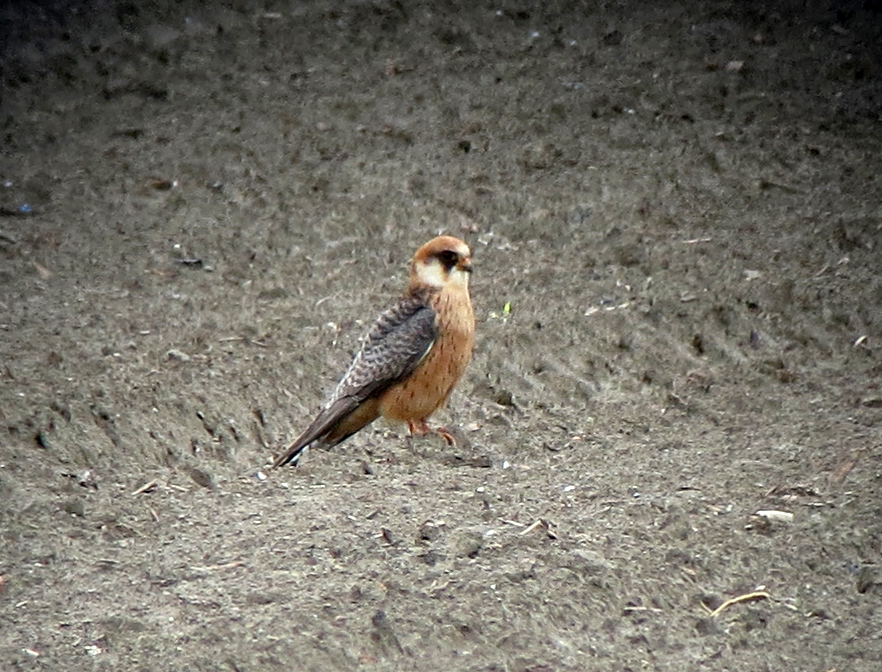
We had a banner day for Red-footed Falcons, with 15 roosting together and then this lone female sitting in a field. Bolle di Magadino
Squacco Heron is a nice bird to find in migration in Switzerland, especially when it's hanging out with a breeding plumage Spotted Redshank and some Common Greenshanks
 One of the benefits of having four scopes and five birders is that there's always a pair of eyes not peering down into a tube.  While we were scoping the Squacco, Natalia spotted a female Little Crake lurking along the boardwalk behind our blind.  She managed to get our attention just in time for it to hop up onto the boardwalk and scurry across into the reeds!

The crake was only bested by our birder friend Tim's spotting of an odd wagtail flocking with a field full of standard Whites following a plow.

The wagtail turned out to be a Pied Wagtail, also known as 'British White Wagtail' following the serial split/lump saga that characterizes the White Wagtail superspecies. The Swiss bird police want documentation for this subspecies and this composite is the image I sent in with my report. Hope it gets accepted!
 We also did some birding down in Sicily this spring while visiting a Sicilian friend of Natalia's.  This Italian island (note: not a part of Switzerland) is famous for its raptor migration, but the winds were wrong, so we opted to spend our limited time searching for mountain and wetland birds.

We dipped on the 'Sicilian' Rock Partridge, allegedly an endemic subspecies, but this Subalpine Warbler consoled us with a territorial show. Sicily


After a lot of misses in Switzerland, we finally saw our first Corn Bunting (and what a drab brown beauty it was). Sicily
Even by land-locked country standards, Switzerland is remarkably depauperate in shorebird habitat. Yeah, you can find some Common Sandpipers and Little Ringed Plovers gleaning the gravel bars along rivers and Eurasian Whimbrels are conspicuous enough in the bare farm fields, but there just aren't any mud or sand flats to serve up that buffet of abundant and diverse waders that a coastal birder craves.

The Vendicari wetland in Sicily more than made up for all the shorebird-less Swiss birding days.

Always nice to spend some quality time with Little Stints. These probably occur regularly as vagrants in North Carolina, but they are just so damn tricky to separate from American peeps...

In short order we had amassed a list of 15 shorebird species, besting our total for all of Switzerland, at one site in just a couple hours. Even Natalia, a self-proclaimed shorebird skeptic, admitted that birding Vendicari was a special experience.

Can you find the Wood Sandpiper lurking among the female Ruffs ('Reeves')? (hint: it looks super scared that you'll notice it)

Natalia and I are off to the 'New World' for a couple months.When we return to Europe in August we will find plenty of low-hanging lifers to find out there in Switzerland and beyond.

Wednesday, March 22, 2017

The Swiss birding squad


Even for somebody like me who has been through the process a few times, moving to a new continent can be a bit intimidating. On top of all the usual challenges in navigating a new culture and physical setting, the critical support networks of friends and families are left behind.

With Natalia off in southeast Asia I was left on my own to bird in a strange Swiss land. The forecast had looked good, but an unexpected dense fog shrouded the landscape, as well as the birds, at the local hotspot, "Katzenseen."

The dense fog at Katzenseen. I felt like I was more likely to encounter an advancing infantry front than a bird.

My early wake-up and pre-dawn arrival proved to be pointless, as I wandered around destitute in the haze for hours while silhouettes of migrating Goldfinches and Fieldfares swirled around in the colorless treetops. Passing hikers said unintelligible things to me. Greetings, presumably, though the Swiss-German accent to my untrained ear recalls more of a fork being dropped into a garbage disposal.

When the sun finally came out after several hours, I blinked at the beautiful landscape I had been until then unable to perceive.  It was quite pretty and I could see the birding potential, but I was starving and it was time to retreat home for lunch. I would have to return another day.

After the fog lifts I can finally see where I am

This was a bit of a lonely and inauspicious early go at Swiss birding for me, but thanks to birding's growing popularity, finding birder friends has become easier than ever.  Within Natalia's work department alone we now know a half-dozen-or-so birders.

So armed with Natalia and some new friends I later returned to Katzenseen to give the place another go.

bird squad at Katzenseen

And of course it was so much more fun, even with a decent snow falling.

The ubiquitous European Robin eating fallen apples in the snow
And this time birds were better and more interesting. Or perhaps it was just that having people along to listen to my jokes and pontifications.

'This treecreeper looks like it could be from Eurasia." This comedic gold would usually be left to bang around inside my own.

I'm finally starting to get a handle on the treecreepers. This is a Short-toed Treecreeper (note the long bill), not to be confused with the nearly identical Eurasian Treecreeper (both are common and widespread in Eurasia)


Finally a decent look at a Fieldfare (if you're not snow blind). The Katzenseen apple orchard was loaded with Thrushes.


Wow, a Black Woodpecker excavating a nest!  This is worth a video.


Best of all, we had a target staked out.
Long-eared Owl, the first I've seen since I saw my lifer in Rhode Island a full decade ago. Fun fact: my life list at that point was less than 300.

Ashwin knew where a group of Long-eared Owls roost, and we were able to tally 11 of them peering out of a dense thicket.

Our report of the owls to eBird drew some attention, and not the hate mail that casually reporting an owl roost usually brings. Some birders from Basel reached out wanting some location details so they could chase.  I offered to lead them to owls the following weekend and earned another couple birder friends. Daniel and Julie also happened to be professional conservation ecologists with a knack for whispering out Water Rails.

Since then I have had the chance to bird a few times at hotspots further afield thanks to my new friends' cars and willingness to drive.

The best, closest birding spot to Zurich is Lake Constanz, which offers an impressive spectacle of waterfowl mega-flocks (the best I've seen outside of North Carolina's Mattamuskeet NWR).

small chunk of mostly Tufted Duck within a raft of 10,000 mixed with Greater Scaup and Common Pochard


Let's take this opportunity to appreciate some of the common Eurasian Waterfowl, like this Eurasian (Common) Teal


Or these Red-crested Pochard (with a Great Crested Grebe), which Natalia considers to be the prettiest duck on the continent. My new Spanish birder friend Josep disagrees (the red bill is too gaudy, he says. I bet he also doesn't like women who wear lipstick).

I had pretty low expectations about Swiss birding when I arrived here in the middle of Europe, but it's been surprisingly fun. Despite having birded a good bit in Greece and Scotland, I've managed to tick 22 lifers during the species-poor winter months.


A recent lifer for me was Lesser Spotted Woodpecker (this one was at Lake Constanz). It may not look like much more than a Downy Woodpecker, but this can be a tricky bird to find.

After a lot of searching I finally found my first Great Bittern at Klingnauer Stausee

Digiscoped pic of my most recent Swiss lifer was Garganey, a bird I had dreamed of seeing as a vagrant in North Carolina. It proved to be easy enough to find at Lake Constanz in March.

This success has all been thanks to my new Swiss-based birding friends (you know who you are). With migration around the corner, I'm sure I'll be out birding with them again soon!

Friday, September 16, 2016

Das Bird


You may have noticed that it has been almost 6 months since my last post.  This isn’t because I haven’t been birding. No way!  If anything, it's because I've been birding too much. In fact I’m in the middle of the biggest birding year of my life (1200+ species, more on that later).

No, what’s been happening is that... how do I say this... writing this blog is a routine. It's something I do regularly and habitually and that I make time for in a normal life schedule.

The problem, though not really a problem at all, is that life has been anything but ‘normal’ or ‘routine.’ Here are some quick highlights of the past 6 months:

-I graduated and earned a PhD
-I got engaged (to Natalia, my birding partner and best friend)
-I bought a house
-I sold my car
-I moved to Switzerland

On top of all that, I’ve been travelling, often in places without much infrastructure, for about 2 of those 6 months.  In fact, as I type this I’m sitting in the Zurich airport about to depart to Singapore for a ~1 month trip to Indonesia—my first time visiting Asia.

But you came here for birds, right? To keep this on topic here’s a bird:

Red Crossbill crush, Lucerne, Switzerland

It’s been a bit of a hectic transition with moving flats, assembling furniture and trying to figure out how transportation and waste management work in this organized little country called Switzerland. I did manage to get out on a couple outings in the 10 days I’ve been here.

Natalia’s work group had a paid hike to Entlebuch a UNESCO world-heritage area and RAMSAR site (wetland of international importance) in the forearc of the Swiss Alps. It features a huge karst formation, bogs and beautiful views of the Swiss countryside. 

Karst slope at Entlebuch - we were hoping to find Rock Ptarmingans here, but they all hid from us

Though we didn’t realize it, we had signed up for a 16 km trek up and down steep grades.  The Swiss are serious about their hiking.  It’s the default hobby here and with lots of mandatory paid vacation time, the modal Swiss person is a super-fit alpine enthusiast. This meant that the pace was a bit too fast for birding. 

Nice view from our picnic spot photo-bombed by a wing-suit diver


Nevertheless we managed to spot a few birds.  My favorite was the Alpine Chough.

Alpine Chough, apparently this is a borderline trashy bird, but it was new for me, so I wasn't complaining

A flock of 50 or so of these nice-looking corvids came cruising along the ridgeline while we ate a picnic lunch. A few stopped close to check us out, probably because they’ve learned that people can be an easy source of food.

Other than that and the crossbill (above) birds were pretty few and far between.  I’ve been told that 16 birds is not a bad number for birding in non-aquatic areas of Europe. This will take some getting used to.

Yesterday I went out with Florian (the same guy who led our Entlebuch hike) out to Neracherried, a Birdlife Switzerland reserve on a remnant wetland near Zurich.  There’s not much to the place: a little visitor’s center and modest-sized patch of reeds with some open water, but it attracts the birds well enough. What it seems to attract best though is photographers.  We showed up during prime sun on a Wednesday evening and could barely wedge ourselves in among the bazooka-sized lenses.

A normal Wednesday afternoon at the Neeracherried photo blinds

I picked up 6 lifers in fairly short order: Curlew Sandpiper, Spotted Redshank, Common Greenshank, Common Ringed Plover, Stock Dove and Marsh Harrier.

Marsh Harrier, Zurich, Switzerland. Kühl!


The birds were kinda far off, so it was mostly scope work. Enjoy these shanks, three green and one spotted red


Common Ringed Plover. Now I'm prepared to find one in North Carolina 

It was great to see some of these European shorebirds. They’re the kinds of birds I always had half an eye out for showing up somewhere in North Carolina.  Now that I’ve seen them in the field, hopefully I’ll have an easier time spotting and identifying one out of range.

The rarest bird of the day ended up being an Osprey, of all things. They’re an uncommon migrant in Switzerland and this was only Florian’s fourth he had ever seen.  All the shutterflies went a bit giddy over this one, even the ones who had no idea what they were shooting picked up on the excitement and rushed outside to get shots as it passed over the blind.

Next post should be about birds in East Kalimantan, or depending on how the flights goes, perhaps an account of some of the cools stuff I’ve been meaning to share from the hiatus.  So we could end up in the Grand Canyon, or somewhere in South America. Who knows!

Thursday, July 19, 2012

Top 10 birds of 2011


Yes, this is coming out 6 months late.  And it is on a much lower plane compared to my top ten from 2010 (it’s what I get for visiting Europe instead of the Neotropics).  But better late than never!

In 2011 I saw 405 bird species, of which 92 were lifers (way down from 907 with 649 lifers in 2010).  About two-thirds of these lifers I found on a couple trips to Europe, with 48 coming while exploring Greece and Croatia and 15 more from a later trip to Prague to attend a Society of Wetland Scientists conference. 

Making a top-10 list is a highly subjective (not to mention silly!) exercise.  Last year every bird I listed was a life bird from the tropics and listed by the IUCN as a species of concern. Also most were endemic and thus could only be found in a relatively small geographic area.  

This time around I didn’t see nearly enough endangered, impossible-to-find birds, so I’m mixing in some somewhat mundane birds that were significant because of where I found them.  But I’m only considering including birds that I found (or co-found); chases don’t count.  So the Allen’s Hummingbird in Catawba Co., NC and the Franklin’s Gull at Jordan Lake, for example, won’t make this list despite being fantastic birds for North Carolina.  Other people (Dwayne Martin and Thierry Besancon) did the hard work of finding and identifying these out-of-range rarities.  

Otherwise I’m making selections based on rarity, difficulty to find and/or identify, and to a lesser extent on charisma/looks.

In keeping with last year, we’ll make this a challenge.  I’m sure many folks have seen many of these birds, but has anybody seen them all?  Send me your total out of ten and whoever has the most will win a prize: an original Brown Boobies t-shirt in the size of your choice (S M L XL). 

On to the list!

* * *

10. Olive-sided Flycatcher

Olive-sided Flycatcher - Pocosin Lakes NWR

This is a declining species that is a pretty rare migrant through North Carolina.  It is especially rare in the coastal plain where there have only been a dozen or so records.  I found mine on August 11 in Pocosin Lakes National Wildlife Refuge.  

Nice tuxedo jacket! A rare sight in coastal NC
*bonus point if you have seen one in the coastal plain of NC*

9. Eurasian Bee-eater

Eating bees! (I think)

Also not particularly rare, but perhaps the most colorful European bird (a relatively unimpressive accomplishment in a continent that has nearly cornered the market on Little Brown Jobs).  I saw hundreds of these (quite a spectacle!) migrating through the Greek Isles while I was Island hopping my way from Rhodes over to my brother’s wedding on Paros. 

Lot's of Bee-Eaters!

8. Greenish Warbler

Greenish Warbler and its genus–phyloscopus—are prime example of the uninspiring plumage and identification challenges that the European birder faces.  It wouldn’t even matter if I had a decent photo of it…it would still be a drab bird and there still would be lingering identification doubts.  Luckily it was singing in the Red Bog I visited on a field trip as part of my conference in the Czech Republic. This wetland we visited has relict boreal vegetation from the Pleistocene and may be one of the southernmost refuges for this high-latitude species.  

7. Anhinga
Anhinga - Durham, NC

Tom Krakauer and I found this bird at a housing development pond in Northern Durham County, which was the first record of the species for the Durham Christmas Bird Count. 

It was a mild enough winter I guess

These are trash birds in Florida, but very rare in Durham...especially so in winter. 
Anhingas in Florida are hard to miss
*bonus point if you've seen an Anhing in Durham*

6. Citrine Wagtail
Citrine Wagtail (female) in Rhodes, Greece - rare this far west

I found a female in a creek bed in Rhodes Greece in May.  It was flagged as "rare" by ebird's filters and apparently it does not frequently stray this far west on its migration.  Unfortunately it was not the colorful male, but I was lucky that it was keeping company with a couple Yellow Wagtails, which made it much easier to identify. 

*bonus point if you've seen a Citrine Wagtail west of Asia*

5. Eleonora’s Falcon
Eleonora's Falcon - light morph

This is a really cool raptor with a relatively small breeding range that covers some Mediterranean Islands.  I saw dozens on the Greek Island of Tilos, which is thought to support 10% of the world's population.  It comes in two color morphs.

Eleonora's Falcon - dark morph

4. Short-toed Eagle

I'm not sure how rare a bird this is, but a woman from the Hellenic Ornithological Society on Tilos told me that it had not been previously recorded on the island.  So it was completely unprecedented  here at least!

Short-toed Eagle - a first for Tilos, Greece

I wrote up a formal description and sent them links to my video, but never heard anything back from any ornithologists or bird records people. 

*bonus point if you've seen Short-toed Eagle on Tilos*

3. Long-billed Dowitcher

Long-billed Dowitcher - Falls Lake, NC

I saw a lot of rare shorebirds on Falls Lake at the end of last summer, but this is the only one that I "discovered."  I was surprised later when I couldn't find any previous records for Durham, so as far as I can tell, this bird was a Durham County first. 

A first for Durham (?)

Perhaps others have had 'dowitcher sp.' at Falls Lake that were suspected of being Long-billed that were never confirmed.  Mine was kind enough to vocalize so there wasn't any doubt.

*bonus point if you've seen Long-billed Dowitcher in Durham*

2. Audouin’s Gull

Audouin's Gull is the only bird on this list that is currently experiencing any sort of extinction risk according to the IUCN which declares it to be 'near-threatened.'  In the 1960s it was one of the rarest gulls on Earth with only some 1,000 remaining.  Now the population is some 10 times the level of its low point, and stable thanks, no doubt, to some diligent effort by conservationists.  Despite the recovery, Audouin's Gull is still a rare bird that is pretty strictly pelagic, so tough to see.  I saw mine from a ferry near Nissyros, Greece.

1. Yellow Rail

I actually went on two successful Yellow Rail trips in 2011. Both were in Carteret County in sections of North River Marsh, one was in January and the other in December. This is one of the most difficult to see of all breeding North American bird species. Our (now infamous) method for finding them is documented here and here.

* * *

So leave your score in the comments below (the bonus points are to break a tie) and take your shot at the prize!  

Hopefully somebody can top Derb Carter (last year's reigning champ).  I haven't gotten him his t-shirt yet, but I'm sure he doesn't need two!