Thursday, June 13, 2013

I know a birder who came from Duluth...

I knew a lady who came from Duluth
She got bit by a dog with a rabid tooth

For some reason the word 'Duluth' always brings to my mind those Nirvana lyrics from "Lake of Fire." Well from this trip I've learned some new associations, and as it turns out, "Lake of Ice," would apply better to this city.

My presentation at the Society of Wetland Scientists annual meeting brought me up to the largest port on the Great Lakes and I managed to work in some birding during the preceding weekend.

It turns out the Park Point area in which I was staying had just experience an epic warbler fallout with 26 species spotted in a morning a few blocks away!  I only caught the tail end of the warbler fest, but it was crazy seeing Canada, Wilson's, Nashville Warblers and Chestnut-sided Warblers flitting around in urban neighborhood shrubs.  Most shocking was the Mourning Warbler I saw scurrying around the mulched plant beds of a downtown city park!  Such birds often require special effort and/or moderate to exceptional luck to find in North Carolina.

This new perspective on which warblers are locally "common" (i.e. those listed above) and which are very rare (i.e. Black-throated Blue, Prairie, Yellow-throated, etc.) was strange, but even more so was the weather.  It would be 72 F and gorgeous and then the wind would shift and it would suddenly be 45 F and impenetrably foggy.
A gorgeous day at Duluth Beach
The mercurial climate is a result of Duluth's position on the shore of Lake Superior, which holds 10 percent of the worlds supply of fresh water and keeps it refrigerated at a refreshing 39 F yearround.  The lake has it's own beaches, sand dunes, ship wrecks, SCUBA divers, surfers, and "sea" birds!

A gull and shorebirds nowhere near the ocean
 The shorebirding on Duluth Beach is pretty slow by North Carolina standards.  The first Wilson's Plover since the 1980's was found here the week before I arrived, but all I could turn up were a few flocks of Sanderlings and Ruddy Turnstones (and my count of 12 turnstones was flagged by the ebird filters as unusually high).

Ruddy Turnstones

Grebing was more exciting...well I was excited to see these grebes anyway.  Rednecks (the kind with wings) are not that easy to find in the Southeast. 
Red-necked Grebes
You know I hate to admit it, but more fun than birding Lake Superior, was paddling out on it to the Apostle Islands Sea Caves.  The wonderful host I found on couchsurfing.com, Deanna, also happened to be a pro kayak trip leader and took me out for free!
Apostle Island Sea Caves
 A combination of wave erosion and uplift created the nooks, arches, tunnels and chasms on this sandstone cliff face that we explored by kayak.  Awesome.

Thanks Deanna!!

It's amazing the nice people you can meet on the internet.  Another was Frank of Minneapolis, who I found through birdingpal.org.

He picked me up and we headed up to the famous Sax-Zim bog where I foolishly hoped to find some of the uncommon boreal specialties, such as Gray Jay, Great Gray Owl and Boreal Chickadee.  I guess they were around there someplace, but apparently finding them is much easier in winter.  The unfamilair songs of Mourning, Connecticut and Nashville Warblers were a treat though.
Mourning Warbler (stick face)
And I got two lifers!:
Black-billed Magpie
and...
Yellow-bellied Flycatcher
 So it ended up being a successful day!  Thanks Frank!

Hilariously, the "best" bird (in terms of local rarity) I saw during my week a Northern Mockingbird.  Apparently Duluth is farther north than this "northern" bird usually cares to stray (but don't be surprised if they become much more common over the next few decades *wink*).

Northern Mockingbird
So I've showcased some pretty poor photos in this post, but here's a better one...

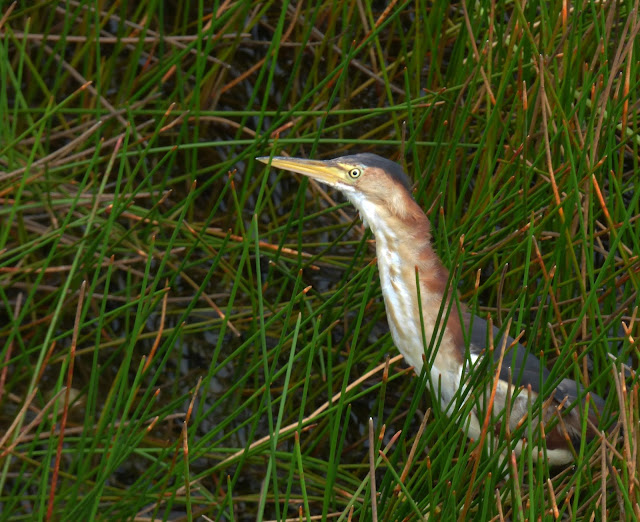
American Bittern
I don't think I'll ever get tired of seeing bitterns.

I managed to sneak out early one morning to find my lifer Trumpeter Swans, but beyond that, most of the birds came on Powerpoint slides.

Duluth was plenty cold for me in June, but I guess I'll have to go back one winter to see Goshawks and Hawk-Owls.

Tuesday, June 11, 2013

Andrea effects at the Outer Banks

The rough seas from the passage of Tropical Storm Andrea cancelled Saturday's pelagic trip, but the storm had left the outer banks littered with interesting birds.

A scruffy-looking Common Eider showed up at Oregon Inlet.  This is a pretty rare bird in North Carolina in the dead of winter, so one in June is especially odd.
Common Eider
It even wattled up on the beach near the coast guard station...I had never seen one stand before!
Common Eider
Eventually it drifted out the inlet with the strong outgoing tide looking a bit storm-weary.

The most buzz came from the 3 to 5 Magnificent Frigatebirds that were seen along the outer banks.  One cooperative pair hovered around the Chicamicomico (Rodanthe) water tower for at least 7 hours.

Magnificent Frigatebird
These birds were in the vicinity of Kitty Hawk Kites and a few dozen kiteboarders were zooming around the sound taking advantage of the high winds.  Perhaps the kites made the frigatebirds feel at home?
Magnificent Frigatebirds
With the recent storm and the wind out of the south I was sure we would get a tropicbird on Sunday's pelagic trip.  Turns out I was wrong...we got something even better.  On our way back in an immature Brown Booby cruised past the boat!

The Booby (and getting to hear Brian Patteson shout "BROWN BOOBY!" over the PA) made up for our failure to find any rare deep sea birds. Normally I would blame the spotting crew (famous big year birders Jeff Lemons and Ali Iyoob, and myself), but it just seemed like there wasn't a ton of pelagic bird activity this day, with a modest showing by the usually-abundant Wilson's Storm-Petrels.  Maybe the storm blew all the birds away?  We did find the expected Corey's, Great and Audubon's Shearwaters; Black-capped Petrels; Ali got Band-rumped Storm-Petrel for his big year list; and a "friendly" Pomarine Jaeger followed us for at least an hour.  So really, even a relatively slow day off Hatteras is still a pretty great day!
Pomarine Jaeger
I found it interesting that all the odd storm-blown birds--the eider, frigatebirds and booby--were all immature/1st-year birds.  Perhaps adults are better at avoiding becoming displaced by severe weather?

Big thanks Brian for having me along to spot again!  For more details on Sunday's trip check out the the Seabirding blog.

Friday, May 31, 2013

A rare pair of Kings

Mark K. was sitting down for some sushi at Carolina Beach in New Hanover County, NC one evening after a day of birding when his friend Ken glanced up at a nondescript bird perched on the power line.

"I don't believe I've seen that kind of bird before."  And for once those words from a novice/non-birder were indeed cause for excitement.  Gray Kingbirds are quite rare in Norther Carolina, and when they appear it usually is not for long. 

Gray Kingbird with (can somebody identify the bee?)
Mark made the ID and got the word out.  Subsequent searching by other birders revealed not one, but two Gray Kingbirds.  Possibly a pair looking to nest?  Apparently that would not be unprecedented in North Carolina, but all previous attempts have been down in Brunswick County, so this could represent the northernmost attempted breeding for the species if they should make a go of it.
Gray Kingbird
A great find by Mark and Ken!  Hopefully other birders can keep tabs on this pair and report on their behavior.

Apparently I was premature in my personal NC vs. ABA list comparison because the gap has just shrunk to 22!

Monday, May 27, 2013

I saw a Saw-whet!

Last weekend Mark K., Ali Iyoob, Natalia Ocampo-Penuela, Jacob Socolar and I birded around Boone for some of the tough-to-find birds that breed in the NC mountains.  It ended up being pretty wet, so I didn't get many photos, but the warblers we saw are pretty tough to capture anyway.
Canada Warbler (female)
Excellent looks at Canada Warblers were nice, but one of our main targets was Golden-winged Warbler, a species listed as near-threatened by the IUCN.  Golden-winged warblers breed in brushy early successional habitats and thus a reason for its decline is said be Re-forestation.  It sounds a bit crazy to blame thriving forests on the plight of a song bird, but historically these creatures probably relied on habitat maintained by large grazing mammals (i.e. Bison) and fires, which have since respectively been extirpated and suppressed.

They can reliably be found at a handful of well-known breeding sites in the mountains of NC, but we had a surprisingly difficult time tracking a them down.  Success came finally late on our final day when we visited Shady Grove Gardens and Nursery.

Golden-winged Warbler - blurry photo by Mark K.
But the best bird of the trip for me was the Northern Saw-whet Owl we heard and, after a couple hours of searching, were eventually able to spot in the boreal forest at Roan Mountain.
Northern Saw-Whet Owl - photo by Mark K.
Despite all the rain this was a really fun trip!  It's hard to go wrong in the NC mountains in May.

--

Some notes for listing nerds:

Since I found Golden-winged Warbler, Willow Flycatcher and Northern Saw-whet Owl on this trip, the only remaining North Carolina breeding bird species I need is Swallow-tailed Kite (and it's breeding status was only confirmed a few weeks ago). 

I'm not much of an ABA area birder. This is mostly because my travel opportunities since I got into birding have either been international or along the East Coast.  Thus, I haven't birded west of Appalachia and my ABA area list is only 23 ticks ahead of my North Carolina list (343).

Next week I'll get to bird in northern Minnesota and hopefully pick up some lifers I'll have no chance of ever seeing in NC: Gray Jay, Black-backed Woodpecker, Boreal Chickadee, Black-billed Magpie, Sharp-tailed Grouse and if I'm really lucky, Spruce Grouse or Great Gray Owl. This trip should push my NC vs. ABA list gap up to 28 or so, but I'll still have opportunities to narrow it back down to 23...or lower. That is until I go bird in California and my ABA list explodes.

Here's a list of birds that are on the NC official bird list that I have only seen outside my home state:

Monk Parakeet
Ring-necked Pheasant
Roseate Tern
Common Ground-Dove
Snowy Owl
Long-eared Owl
Mourning Warbler
American Tree Sparrow
White-winged Crossbill
Limpkin
Black-bellied Whistling-Duck
Gray Kingbird
Mottled Duck
Swallow-tailed Kite
Black-headed Gull
Western Kingbird
Philadelphia Vireo

Sunday, April 28, 2013

Evening Grosbeaks in North Carolina

Somehow I ended up birding the NC mountains last weekend.

Why? 
Evening Grosbeaks
I blame Mark K.  I had resigned myself to never see an Evening Grosbeak, but when he offered to do the driving and had a free place to stay, how could I say 'no?'

Evening Grosbeaks
What an awesome bird!

This was supposedly an irruption year for Evening Grosbeaks in North Carolina, the first since about 1996.  But other than a few flyovers and fleeting glimpses by feeder-watchers, the species all but eluded triangle birders.  Whether their scarcity was because the invasion was overblown or because of the species' troubling decline in recent decades, I can't say. 

Evening Grosbeaks
All I know is that four pairs (at least) showed up in Bryson City, NC this April and have been essentially the only ones to stay in place long enough for NC birders to see in the past decade or so. 
Mark and I with Andy Zivinsky, the Evening Grosbeak host and owner of Bryson City Bicycles

A big thanks to Andy Zivinsky of Bryson City Bicycles for being so generous with his time and yard!

~~~
Some notes for listing nerds:

This was North Carolina bird #340 for me.  I've still got a dozen or so reasonably target-able birds to find in NC, but after 350, the diminishing returns really kick in and it'll be mostly about having luck on Christmas Bird Counts and chasing down rarities to add state ticks.

Here's my prediction for the next 10 NC species that would take me to #350:

Willow Flycatcher - I'm pretty sure I've already seen one at Mason Farm, but it didn't call and so went down as Empidonax sp.  
Golden-winged Warbler - I should get this (and above) in a few weeks if I go up to the New River near Boone
Northern Saw-whet Owl - the last NC breeder I need as a lifer.  I tried for and missed it on this Grosbeak trip
Swallow-tailed Kite - I have a chance to find one with Ed Corey at the Cape Fear during Wild-a-Thon
Leach's Storm-Petrel - I've got plans to spot on some pelagics this summers, so I might get one or two of the four pelagic species listed here
Sooty Shearwater
White-tailed Tropicbird
South Polar Skua
Hudsonian Godwit - Mattamuskeet is supposed to be a good place to see them and fall and I'll be out that way doing field work
Yellow-bellied Flycatcher - A rare fall migrant I hope to stumble upon

With some luck, I'll get to 350 before next winter one way or another...probably with four of five from the list above.  Winter birds I need, like Western Kingbird, Glaucous Gull and Cave Swallow, should come in the next batch.


Friday, April 26, 2013

Why did the grouse cross the road?

The eternal grouse question for birders in North Carolina is more typically "why can't I ever see one?"  And for folks who don't live in the mountains, a grouse sighting is usually cause for some celebration.  Last weekend Mark K. and I enjoyed a bit of a grouse party along Clingman's Dome Road in the Great Smoky Mountains National Park.

A Ruffed Grouse showing off its "ruff"

 We talked to some Appalachian Trail hikers, who said there was lots of drumming going on and while walking a trail looking for salamanders I noticed one a mere 20 feet ahead of me wandering along the forest floor.  I just missed getting a pretty stellar grouse shot (stupid twig).
Ruffed Grouse

Watching a grouse from such short range and then have it trot across the road like a chicken was quite a sight (and the inspiration for this post's title).
Ruffed Grouse crossing the road
I'm no authority, but for those Carolina birders still trying to find a grouse (and I know a few), it sure seems like checking out Clingman's Dome Road on an afternoon in April is the way to go!

Thursday, April 11, 2013

Surveying a Snowy Plover

Counting Shorebirds for the International Shorebird Survey - photo by Mark Kosiewski
Bear Island is one of the few remaining undeveloped barrier islands along the east coast of the US.  Its wide open sandflats and dunes provide precious habitat for rapidly declining species of migrating shorebirds.

As part of the International Shorebird Survey, my fellow citizen scientists, Ed Corey, Mark Kosiewski, Natalia Ocampo-Penuela, and I, grabbed our scopes and counted hundreds of sandpipers, plovers and dowitchers. 

Of course it was a rare bird that enticed us to make the trip...

Snowy Plover
Snowy Plovers do not regularly appear on the Atlantic coast (and this was a lifer for me!), but over the years, a handful have turned up on various North Carolina beaches.  Ed Corey found this individual back in February.  I wonder how long it will stick around.

It seemed to be right at home (and was well-camouflaged) on the sand flats.  It would tilt its head at odd angles and zip around with remarkable speed making photography a bit of a challenge, but it did not seem particularly concerned about our presence.  Check out the video!


We found a whopping 5 plover species on the day (and 6 on the trip if you count the Killdeer we saw on the mainland), with plenty of Black-bellied and Semipalmated Plovers, a couple dozen of the controversial Piping Plover and more Wilson's Plovers than I had ever seen...
Wilsn's Plover
 ...we counted about 80, which seemed like more than the island could support since they were constantly chasing each other around the beach.

I was too busy counting birds to try to digiscope any of the other species, but there were several of the rare Red Knot, a couple hundred Long-billed Dowitchers, and the ubiquitous Sanderlings, Ruddy Turnstones and Willets.  The most numerous bird was Dunlin--we tallied some 1700.

Hopefully our survey will in some small way help these populations.  It sure was fun counting them and the setting was beautiful!

Big thanks to Ed, for originally discovering the Snowy Plover and arranging the ferry, UTV and State Park barracks for us.


Thursday, March 14, 2013

Spotting on the Stormy Petrel II part 2

Spotting on the Stormy Petrel II

For the second time I enthusiastically jumped at the opportunity to spot on one of  Brian Patteson's Pelagic trips out of Cape Hatteras.  The first time was last August, but I actually have more experience off shore in the wintertime, so I felt relatively qualified.

Of course everybody wants an albatross now, so meeting expectations is tough!

No albatross, but we ended up having an awesome day for birds.  Great Skua is almost always the top (reasonable) target and we had decent looks at two!  There were more Manx Shearwaters around than I had ever seen with as many as four visible at a time and a count for the trip around 20.  A few flocks of Red Phalaropes made a brief showing as well.

But the alcid numbers on the trip were absurd.  They were, roughly: 1000 Razorbills, 100 Dovekies and 10 Atlantic Puffins. (edit--official alcid counts were: 2000 Razorbills, 232 Dovekies, and 15 puffins).
Immature Atlantic Puffin

To me those numbers say there should have been 1 Murre out there somewhere to fill out the 10-fold alcid dilution ratio.  Sadly I wasn't able to spot one. 

 My proud moment instead came from spotting an odd bird in the Hitchcockian gull flock (fortunately they're just after chum and not us)...

See anything unusual?
 That's right an Iceland Gull!  I had never seen an adult before, so while not a tick, I still felt like this was a "lifer."


Adult Iceland Gull - it has some faint gray in the wingtips making it a kumlieni
More details on this trip can be found at Brian's Seabirding blog. A big thanks to Brian and Kate for having me aboard.

After the successful pelagic, Ed Corey was nice enough to me up for the night at Jockey's Ridge State Park.  Early the next morning, before heading onto Mattamuskeet (where I would stumble upon a White-faced Ibis), Mark Koseiwski and I ventured out into the dunes to find a flock of four Snow Buntings.
Snow Buntings
I had been trying to see this species at the coast of NC all winter, so I was glad to finally see this little flock!

Hopefully I'll get back out to Hatteras once the spring/summer season starts up...

Monday, February 25, 2013

North Carolina's third record of White-faced Ibis (Plegadis chihi)

Prudence dictates that I should put a question mark at the end of this post title, especially with a tough ID call like this...


...but tell me this isn't a White-faced Ibis.


The red eye and pink facial skin is glaring.

The suspect was hanging out in a flooded field at the east end of Lake Mattamuskeet in Hyde Co., NC in the company of about a dozen Glossy Ibises.  While superficially very similar (and apparently there is integradation between these species), in a scope from ~50 yards this bird stood out. 

Put the head away for a second and look at the leg color for example... pinkish-red on the White-faced and a cold gray on the Glossies.


Also the White-faced Ibis seemed to have slightly lighter-colored plumage and I noticed more tones of fuschia than in the darker Glossies.


This was pronounced enough so that even with the heads hidden you can tell which is the odd bird out (and which is the Boat-tailed Grackle). 


So I think I'll have to fill out some paperwork on this one for the NC Bird Records Committee.  Luckily the area where it was found opens up to the public for the season starting the Friday, so maybe some others will be able to see it.

Saturday, February 9, 2013

Charlotte Chase!

Ed Corey, Nick Flanders, Natalia Ocampo-Penuela and I drove down to the Charlotte (pronounced this day with a hard ch-) area today to see a couple odd western species that had been showing up at feeders. 

The first target was a Bullock's Oriole.  After 20 or 30 minutes of waiting in a lovely yard he showed up to survey the buffet options that his hosts had left out for him.
Bullock's Oriole! (adult male)
He used several of the many feeding stations including the ant trap above the hummingbird feeder.  Was he taking advantage of the free insects or just getting a drink?

Eating ants or drinking water?

What a beautiful bird and a lifer for all of us except Ed!  That's 3 North American Orioles down and 5 to go. 

~

Our next stop was just up the road in Monroe, NC where a couple western hummingbird species have been spending the winter.

While we waited for them to show, we entertained ourselves by looking at a couple oddly white Carolina Chickadees that inhabit the yard.

Leucistic (?) Carolina Chickadee
I had never seen a chickadee like this before!  It must have some sort of pigment deficiency?

Eventually our first hummingbird showed up...

Calliope Hummingbird
This is a terrible, distant photograph, but the short tail (completely hidden behind the front wing) and the streaky throat make this bird a Calliope Hummingbird.

It wasn't a stunner like the oriole was and didn't give us such prolonged views, but it was a lifer for all of us except for Nick, so we didn't care. 
Rufous Hummingbird
The Calliope disappeared quickly because this larger, more aggressive Rufous Hummingbird arrived to have his turn at the feeder.

Bird chasing is always a risky business, but today we lucked out and swept our targets quickly!  A big thanks to the hosts, Noreen George and Cynthia Hinson, for sharing their rare birds.


Friday, February 1, 2013

Leadin' field trips down east

North Carolina's Albemarle Peninsula and Outer Banks make up a world-class birding destination in mid-winter, with waterfowl galore, and a healthy diversity of waders, shorebirds and sparrows.

I had the honor of leading field trips 'Down East' (as it's called) in back-to-back weekends.

Trip 1: Duke Conservation Society / Nicholas School Naturalists / Student Association of Wetland Scientists trip to Mattamuskeet
National Wildlife Refuge

A couple weeks ago Jeff Pippen and I took a group of 21 master's students from the Nicholas School down to Lake Mattamuskeetfor an unseasonably warm and sunny day of birding.

Lots of happy students
Bird highlights were a Eurasian Wigeon (thanks to Thierry Besancon, who we bumped into with a group from New Hope Audubon), a brief, but diagnostic glimpse of an Ashe-throated Flycatcher (the second one I have found in NC in as many months) and a very photogenic Anhinga.

Anhinga
I used this opportunity to swap SD cards and batteries for the cameras at my research site...

photo by Emma Hedman


Trip 2: Carolina Bird Club Winter Meeting at Nags Head, NC

This past weekend the Carolina Bird Club held its winter meeting at Nags Head, a launching point for a heap of the state's top birding hotspots.  I led 3 half-day trips around Bodie Island over Friday and Saturday.

The Bodie Lighthouse pond is the best place I know to get close enough to photograph (or in this case digiscope) ducks...


Northern Pintail and Northern Shoveler

sleepy Gadwall pair
American Avocets, Green-winged Teal and Northern Pintail
Oregon Inlet always has something interesting going on bird-wise. This weekend the highlight for many of the birders on my trips were a pair of Purple Sandpipers at the end of the jetty.

Purple Sandpipers
On the way back west I dropped by the 'sparrow fields' by Lake Phelps.  The hotspot lived up to its name and the adjacent shrub line was loaded with oddball sparrows that are usually pretty hard to come by in North Carolina...
Vesper Sparrow

Vesper Sparrows

Vesper Sparrow and Clay-colored Sparrow